Claude Monet Houses of Parliament National Gallery of Art
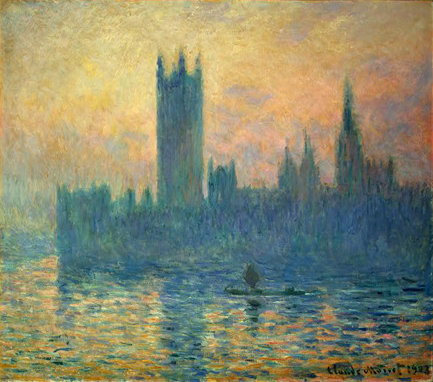
"The Houses of Parliament, Sunset" by Claude Monet
"The Houses of Parliament" past Claude Monet is i in a series of paintings of the Palace of Westminster, dwelling house of the British Parliament, created during the early 1900s while Monet stayed in London. All of the serial of paintings with similar titles share the same viewpoint from Monet's terrace at St Thomas' Infirmary overlooking the Thames. The set of pictures draw dissimilar times of the day, and various weather and calorie-free conditions, interestingly all on canvases are of approximately similar size.
This painting's viewpoint was close to that of J. M. West. Turner's paintings of the burn that had destroyed much of the onetime Parliament circuitous in 1834. Artworks of the Thames by James McNeill Whistler also inspired Monet.
By the time of the Houses of Parliament series, Monet had ceased his earlier practice of completing a painting on the spot in front of the subject. Monet continued refining the images back at his home base of operations in French republic and sometimes used photographs to assistance in his task. Some purists criticized this new arroyo, only Monet replied that his means of creating work was his own business, and it was up to the viewer to judge the terminal upshot.
Monet produced nearly a hundred views of the Thames River in London. He painted Waterloo Bridge and Charing Cantankerous Bridge from his room in the Savoy Hotel and the Houses of Parliament from Saint Thomas's Hospital. The artist continued to refine the paintings and wrote to his art dealer:
"I cannot ship you a single canvas of London … It is indispensable to accept them all before me and to tell the truth, not i is definitely finished. I develop them all together."
Oscar-Claude Monet was a founder of French Impressionist painting, and the term "Impressionism" is derived from the title of his painting Impression, "Soleil Levant" or "Impression, Sunrise," which was exhibited in 1874. Monet adopted a method of painting in which he painted the aforementioned scene many times to capture the changing of light and the passing of the seasons. Monet is known for having produced a serial of paintings, all versions of the same subject and perspective. Examples include his series of the "Valley of the Creuse" serial and his famous series of "Haystacks" and "Water Lilies" paintings.
From 1883 Monet lived in Giverny, where at his home, he adult a garden landscape that included the lily ponds that would become the subjects of his best-known works. In 1899 he began painting the water lilies, firstly with a Japanese bridge as a cardinal characteristic, and after in the serial of large-scale paintings, with the water lilies equally the main feature. This serial occupied him for the concluding xx years of his life.
The Houses of Parliament, Sunset
- Title: The Houses of Parliament, Sunset
- Français: Le Parlement de Londres, Soleil couchant
- Creative person: Claude Monet
- Year: 1903
- Medium: Oil on canvas
- Dimensions: 81.3 × 92.five cm (32 × 36.four in)
- Museum: National Gallery of Fine art, DC
Claude Monet
- Proper name: Oscar-Claude Monet
- Born: 1840 – Paris, France
- Died: 1926 (aged 86) – Giverny, France
- Nationality: French
- Movement: Impressionism
- Notable works:
- Reflections of Clouds on the H2o-Lily Pond
- Farmyard in Normandy
- The Basin at Argenteuil
- A Cart on the Snowy Road at Honfleur
- Water Lilies, (National Museum of Western Art, Tokyo)
- Camille Monet on a Bench
- The Houses of Parliament (Effect of Fog) – (MET)
- "Houses of Parliament, London" (Art Institute of Chicago)
- "The Houses of Parliament, Sunset" (National Gallery of Art, DC)
- London, Houses of Parliament. The Lord's day Shining through the Fog
- "Seagulls, the River Thames and the Houses of Parliament" (Pushkin Museum)
- Haystacks at Scottish National Gallery
- Stacks of Wheat (Stop of 24-hour interval, Autumn) at Art Institute of Chicago
- Stacks of Wheat (Finish of Summer) at Art Institute of Chicago
- "Meules, milieu du jour" (National Gallery of Australia)
- "Wheatstacks, Snowfall Upshot, Morning time" (Getty Museum)
- Garden at Sainte-Adresse
- Poppy Field in a Hollow nearly Giverny
- The Gare St-Lazare (The National Gallery, London)
- "La Gare Saint-Lazare" (Musée d'Orsay)
- "Inflow of the Normandy Train, Gare Saint-Lazare" past Claude Monet (Fine art Found of Chicago)
Claude Monet – Interesting Facts
- Monet was Paris-born but was raised on the Normandy Coast.
- Monet began drawing every bit a young male child, sketching his teachers and neighbors.
- Monet had an estranged relationship with his begetter. His male parent did not support his artistic passion and was unwilling to help him financially.
- In 1858, Monet met Eugène Boudin. Boudin became his mentor and encouraged him to paint "en obviously air."
- In 1861, Monet was drafted into the ground forces and join the Starting time Regiment of African Light Cavalry, he served in Algeria, a territory that was and then controlled by France.
- Monet lived in Argenteuil from 1871 to 1878, where he was drawn to the natural beauty, and he painted 170 canvases during his time in Argenteuil.
- For the year of the first Impressionist exhibition in 1874, Monet painted the Argenteuil Bridge seven times.
- Japanese fine art fascinated Monet, attending a Japanese exhibition in the 1890s. He amassed a collection of more 200 Japanese prints over the years.
- France's traditional fine art institutions were not fans of the Monet'due south style. The saw his style equally "coincidental" and "incomplete."
- His style focused on perception, capturing outdoor scenes by using rapid brush strokes.
- In his late 20s, Monet was depressed and struggling to support himself and his family unit financially, Monet jumped off a bridge in 1868. Fortunately, he survived his fall.
- Monet destroyed hundreds of his works due to bouts of frustration and self-doubt.
- Monet was baptized Catholic, simply he went on to get an atheist.
- Monet disliked traditional art schools. Then he became a pupil of Swiss artist Charles Gleyre. It was here that Monet met Pierre-Auguste Renoir, Frederic Bazille, and Alfred Sisley.
- With the younger artists, Monet explored new approaches to art like distinctive brush strokes and accurate depiction of light and unusual visual angles.
- Outdoor painting was critical in developing his style. He created a series of pictures where he explored the furnishings of rain, mist, smoke, and steam on landscapes and objects.
- The term "Impressionism" was used as a derogatory characterization in a disquisitional review of artists who used the Impressionists style; information technology was borrowed from Monet'due south painting championship chosen "Impression: Sunrise."
- Monet claimed that he titled the painting Impression, Sunrise due to his hazy painting style in his depiction of the bailiwick.
- In his about famous serial of 20-half-dozen views of Rouen Cathedral, he broke tradition and cropped the Cathedral views, so that simply a portion of the facade is seen on the sail.
- Monet's favorite model was his first wife, Camille Doncieux. She appeared in around 32 paintings.
- Monet's second married woman, Alice Hoschedé, was irrationally jealous of his showtime married woman, who had died.
- Monet suffered from cataracts in his afterward years.
- In 1883, Monet moved to the small village in Giverny and spent 10 years edifice the h2o garden, where he painted peradventure his near famous works.
- As Monet's garden expanded, he hired six gardeners to tend to it.
- Ane gardener's chore was to paddle a boat onto the pond each morn, washing and dusting each lily pad.
- Monet's series of Water Lilies consists of about 250 oil paintings, which were painted during the last thirty years of his life.
- Monet's famous Japanese bridge over his Giverny swimming remains to this day at his home in Giverny.
- For the last 25 years of his life, Monet painted the water lilies in a series of paintings that water lilies in different light and textures.
- In 1926, Monet died of lung cancer at the age of 86.
- Monet is buried in the Giverny church building cemetery.
- In 1980, his former habitation in Giverny was opened to tourists to encounter his gardens, woodcut prints, and souvenirs.
- Monet'southward Giverny garden, bedchamber, studio, and blue sitting-room are open for tours.
A Tour of the National Gallery of Art, DC
- "Ginevra de' Benci" by Leonardo da Vinci
- "A Immature Girl Reading" by Jean-Honoré Fragonard
- "Pocket-size Cowper Madonna" by Raphael
- "The Alba Madonna" by Raphael
- "Nude on a Divan" by Amedeo Modigliani
- "Nude on a Bluish Cushion" by Amedeo Modigliani
- "Saint Jerome" past El Greco
- "The Houses of Parliament, Dusk" past Claude Monet (National Gallery of Art, DC)
- "Breezing Upward (A Fair Wind)" by Winslow Homer
- "Madame Moitessier" past Jean-Auguste-Dominique Ingres
- Adrienne (Adult female with Bangs) by Amedeo Modigliani
- "Watson and the Shark" by John Singleton Copley
- "The Emperor Napoleon in His Report at the Tuileries" by Jacques-Louis David
- "The Boating Political party" past Mary Cassatt
- "Interior of the Pantheon, Rome" by Giovanni Paolo Panini
- Marcelle Lender Dancing the Bolero in "Chilpéric" by Henri de Toulouse-Lautrec
- "Quadrille at the Moulin Rouge" past Henri de Toulouse-Lautrec
- "A Dutch Courtyard" by Pieter de Hooch
- "The Mother and Sister of the Artist" past Berthe Morisot
- "New York" past George Bellows
- Self-Portrait by John Singleton Copley
- "Self-Portrait" by Benjamin W
- "Symphony in White, No. i" by James Abbott McNeill Whistler
- Masterpieces of the National Gallery of Art
Reflections
- "I would like to paint the mode a bird sings." – Claude Monet
- "The noblest pleasure is the joy of agreement. " – Claude Monet
- "The light constantly changes, and that alters the temper and beauty of things every infinitesimal." – Claude Monet
- Which is your favorite painting of the Houses of Parliament?
- Which is your favorite Monet series?
- The Houses of Parliament
- H2o Lilies
- Valley of the Creuse
- Haystacks
- Thousand Canal, Venice
- Rouen Cathedral
~~~
"Everyone discusses my art and pretends to understand,
as if it were necessary to sympathise when it is simply necessary to love."
– Claude Monet
~~~
Photograph Credit: one) [Public domain], via Wikimedia Eatables
Pop this Week
Sponsor your Favorite Folio
SEARCH
Source: https://joyofmuseums.com/museums/united-states-of-america/washington-d-c/national-gallery-of-art-dc/the-houses-of-parliament-sunset-by-claude-monet-national-gallery-of-art-dc/
0 Response to "Claude Monet Houses of Parliament National Gallery of Art"
Post a Comment