C# Create a Text File and Upload to Raspberry Pi
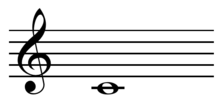
C or Practice is the first annotation of the C major scale, the tertiary note of the A minor scale (the relative modest of C major), and the fourth note (Thousand, A, B, C) of the Guidonian hand, commonly pitched around 261.63 Hz. The bodily frequency has depended on historical pitch standards, and for transposing instruments a stardom is fabricated between written and sounding or concert pitch.
In English the term Do is used interchangeably with C merely by adherents of fixed-Exercise solfège; in the movable Do system Practise refers to the tonic of the prevailing key.
Frequency [edit]
Historically, concert pitch has varied. For an instrument in equal temperament tuned to the A440 pitch standard widely adopted in 1939, heart C has a frequency around 261.63 Hz (for other notes see piano key frequencies). Scientific pitch was originally proposed in 1713 past French physicist Joseph Sauveur and based on the numerically convenient frequency of 256 Hz for middle C, all C's existence powers of two. After the A440 pitch standard was adopted past musicians, the Acoustical Guild of America published new frequency tables for scientific use. A movement to restore the older A435 standard has used the banners "Verdi tuning", "philosophical pitch" or the easily confused scientific pitch.
Octave nomenclature [edit]
Eye C [edit]
MiddleC (the fourth C key from left on a standard 88-cardinal piano keyboard) is designated C4 in scientific pitch notation, and c′ in Helmholtz pitch note; it is note number threescore in MIDI notation.[1]
While the expression Centre C is generally clear across instruments and clefs, some musicians naturally use the term to refer to the C annotation in the centre of their specific instrument's range. C4 may be chosen Low C by someone playing a Western concert flute, which has a higher and narrower playing range than the piano, while C5 (523.251 Hz) would be Eye C. This technically inaccurate practice has led some pedagogues to encourage standardizing on Cfour every bit the definitive Middle C in instructional materials across all instruments.[2]
On the K Staff, MiddleC is notated with a ledger line higher up the top line of the bass staff or beneath the lesser line of the treble staff. Alternatively, information technology is written on the heart line of a staff using the alto clef, or on the fourth line from the bottom, or the second line from the top, of staves using the tenor clef.
Other octaves [edit]
In song music, the term High C (sometimes less ambiguously chosen Top C [3]) can refer to either the soprano's C 6 (1046.502 Hz; c′′′ in Helmholtz annotation) or the tenor'south C 5; both are written as the C two ledger lines above the treble clef but the tenor vocalisation sings an octave lower. The term Low C is sometimes used in song music to refer to C 2 because this is considered the divide between true basses and bass-baritones: a basso can sing this note easily, whereas other male person voices, including bass-baritones, typically cannot.
Tenor C is an organ architect's term for small C or C 3 (130.813 Hz), the note one octave below Middle C. In older stoplists it usually means that a rank wasn't yet full compass, omitting the bottom octave, until that Bottom Octave was added afterwards on.
Designation past octave [edit]
| Scientific designation | Helmholtz designation | Octave proper noun | Frequency (Hz) | Other names | Audio |
|---|---|---|---|---|---|
| C−1 | C͵͵͵ or ͵͵͵C or CCCC | Octocontra | 8.176 | Quadruple Low C (64' Organ Pipes) |  Play(aid·info) Play(aid·info) |
| C0 | C͵͵ or ͵͵C or CCC | Subcontra | 16.352 | Triple Low C (32' Organ Pipes), Octobass C | Play(assist·info) |
| Cone | C͵ or ͵C or CC | Contra | 32.703 | Double Low C (16' Organ Pipes), (Double Bass due west/ either Low C Extension, 5 Strings, or in 5ths Tuning) | Play(help·info) |
| C2 | C | Great | 65.406 | Low C, cello C, viii' C (see organ pipe length) | Play(assistance·info) |
| C3 | c | Small-scale | 130.813 | 4' C or Tenor C (organ), viola C, Tenor Center C (Tenor Voice) | Play(help·info) |
| Cfour | c′ | One-lined | 261.626 | Middle C for Sopranos 2' Organ pipes | Play(help·info) |
| C5 | c′′ | Two-lined | 523.251 | Treble C, Tenor Loftier C (written an octave higher for tenor voices), [iv] one' Organ Pipes | Play(aid·info) |
| Csix | c′′′ | Three-lined | 1046.502 | High C (soprano) | Play(assistance·info) |
| C7 | c′′′′ | Iv-lined | 2093.005 | Double loftier C[ citation needed ] | Play(assist·info) |
| C8 | c′′′′′ | V-lined | 4186.009 | Eighth octave C, triple high C | Play(aid·info) |
| C9 | c′′′′′′ | Six-lined | 8372.018 | Quadruple high C | |
| C10 | c′′′′′′′ | Seven-lined | 16744.036 | Quintuple high C |
Note that for a classical piano and musical theory, the middle C is unremarkably labelled as C4; However, in the MIDI standard definition (like the one used in Apple's GarageBand), this eye C (261.626 Hz) is labelled C3. In do, a MIDI software can characterization middle C (261.626 Hz) as C3-Cv, which can cause defoliation, especially for beginners. The frequencies given in this table are based on the standard that A=440Hz and with equal temperament
Graphic presentation [edit]


Position of Middle C on a standard 88-primal keyboard
Scales [edit]
Common scales beginning on C [edit]
- C Major: C D E F G A B C
- C Natural Minor: C D East ♭ F 1000 A ♭ B ♭ C
- C Harmonic Pocket-size: C D Eastward ♭ F G A ♭ B C
- C Melodic Small Ascending: C D E ♭ F Thousand A B C
- C Melodic Pocket-sized Descending: C B ♭ A ♭ K F E ♭ D C
Diatonic scales [edit]
- C Ionian: C D Eastward F G A B C
- C Dorian: C D E ♭ F G A B ♭ C
- C Phrygian: C D ♭ E ♭ F G A ♭ B ♭ C
- C Lydian: C D Due east F ♯ G A B C
- C Mixolydian: C D E F G A B ♭ C
- C Aeolian: C D E ♭ F G A ♭ B ♭ C
- C Locrian: C D ♭ East ♭ F G ♭ A ♭ B ♭ C
Jazz melodic minor [edit]
- C Ascending Melodic Minor: C D E ♭ F G A B C
- C Dorian ♭2: C D ♭ E ♭ F G A B ♭ C
- C Lydian Augmented: C D E F ♯ K ♯ A B C
- C Lydian Dominant: C D E F ♯ Chiliad A B ♭ C
- C Mixolydian ♭vi: C D E F Thou A ♭ B ♭ C
- C Locrian ♮two: C D E ♭ F G ♭ A ♭ B ♭ C
- C Altered: C D ♭ E ♭ F ♭ G ♭ A ♭ B ♭ C
See also [edit]
- Piano cardinal frequencies
- A440 (pitch standard)
- C major
- C minor
- Root (chord)
References [edit]
- ^ "MIDI Note/Key Number Chart", computermusicresource.com
- ^ Large, John (February 1981). "Theory in Practice: Building a Firm Foundation". Music Educators Journal. 32: thirty–35.
- ^ Harold C. Schonberg (November 4, 1979). "Birgit Nilsson – The Return of a Super-Soprano". The New York Times.
- ^ "The Note That Makes Usa Weep" past Daniel J. Wakin, The New York Times, September 9, 2007
Source: https://en.wikipedia.org/wiki/C_(musical_note)
0 Response to "C# Create a Text File and Upload to Raspberry Pi"
Post a Comment